> ## Documentation Index
> Fetch the complete documentation index at: https://docs.skatechain.org/llms.txt
> Use this file to discover all available pages before exploring further.
# Skate AMM Fundamentals
### What is Skate AMM?
Our flagship product, **Skate AMM**, is a **crosschain AMM** designed to elevate the native user experience across chains by introducing a revolutionary pricing and liquidity model.\
Built on Skate’s core design principles of **composability and single application state**, the Skate AMM leverages an **aggregated bitmap that delivers a single, unified price across all connected chains**.
This pricing mechanism mirrors the proven structure of a Uniswap V3 pool, yet extends beyond single-chain limitations to provide a truly cross-chain liquidity experience.
***
### Stateless Pattern in Action
Adopting the **stateless pattern** that governs all Skate-based applications, the core state for the AMM is hosted on **Skate (the hub chain)**.
This implies that:
* The **hub chain (Skate)** hosts the **canonical state** of all AMM pools — including tick bitmaps, liquidity positions, and global fee accumulators.
* Each connected **periphery chain** (e.g., Solana, Sui, Ethereum, etc.) maintains **minimal periphery state** to enable fast, native execution that references the hub’s canonical state during runtime.
***
### Source Chain (Periphery)
1. **Quote retrieval**\
The user or front-end fetches a quote, either off-chain via an aggregator or directly from pool data hosted on **Skate**.\
This ensures the swap references the canonical, hub-validated state.
2. **Swap initiation**\
The user submits a swap action on the source chain. Their input asset (e.g., USDT) is transferred from the user’s wallet into the **local periphery pool**.
3. **Action registration**\
The swap intent is emitted as an event and indexed by the **executor network**, which observes periphery activity and relays actions to the hub chain for deterministic settlement.
***
### Hub Chain (Skate)
1. **Canonical execution**\
The executor triggers the swap logic within the **Skate kernel**, referencing the pool’s canonical state (tick bitmap, liquidity ranges, and fee growth).
2. **State update**\
The pool state is atomically updated on the hub — reflecting new price ticks, fee accruals, and global liquidity deltas.
3. **Task creation**\
Once executed, the kernel emits a **task event** containing details such as:
* user address
* tokenIn / tokenOut
* slippage
* amountIn / amountOut
* deadline
This task is indexed and queued by executors for dispatch to the relevant destination chain.
***
### Destination Chain (Periphery)
1. **Task execution**\
The executor submits the verified task to the periphery contract on the destination chain.
2. **Asset delivery**\
The pool vault on that chain transfers the output asset (e.g., USDC) to the user’s wallet.\
Final settlement mirrors the hub’s canonical record, ensuring consistency across chains.
***
### Unified Liquidity Model
At the heart of Skate AMM lies its **Unified Liquidity Model** — a system that transcends traditional, chain-specific liquidity fragmentation.
Instead of each network maintaining its own isolated pool, Skate aggregates liquidity across all connected chains into a **single virtual pool** governed by a unified price curve.
Under this model:
* **All price discovery and liquidity accounting occur on the hub chain (Skate)**.
* **Actual tokens remain native and transacted on the respective periphery chains.**
The hub maintains only the **logical state** of the pool — tick bitmaps, liquidity positions, and fee growth — serving as the single source of truth for pricing and liquidity distribution.
Each periphery chain executes swaps using the **price and outcome computed by the hub**, moving tokens locally to complete settlement.\
The hub remains the source of truth for all pricing and liquidity accounting.
This architecture ensures:
* **Unified pricing:** every trade on any chain references the same hub-validated state root, maintaining global price consistency.
* **Cross-chain depth aggregation:** liquidity from all chains contributes to a single price curve, maximizing liquidity depth and minimizing slippage.
* **Stateless yet verifiable execution:** periphery environments execute locally without persisting pool logic, ensuring lightweight composability.
* **Atomic global updates:** the hub serializes all fee, tick, and liquidity updates, preserving deterministic order across chains.
In effect, **pricing and state are centralized on the hub**, while **liquidity and execution remain decentralized across periphery chains**, giving users the experience of trading against a single global pool — regardless of where they are.
***
### Multichain Pricing Curve
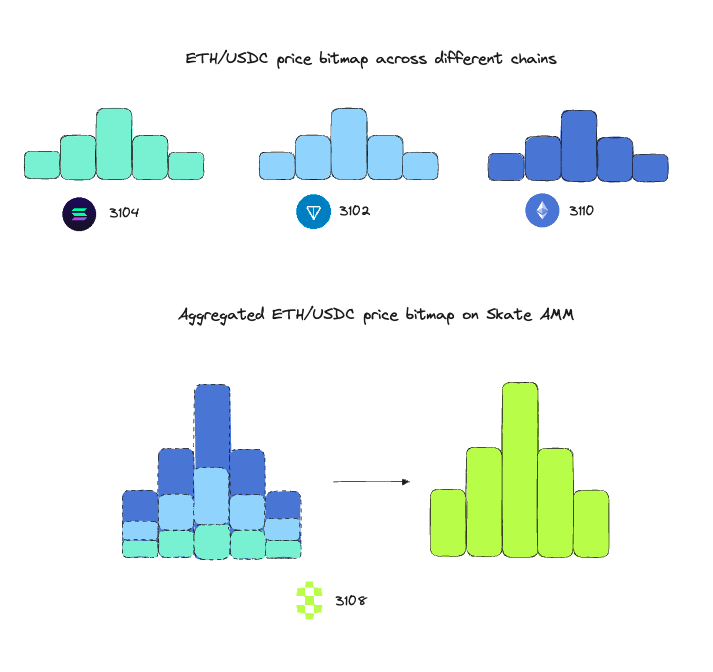 Each connected chain (e.g., Solana, Sui, Ethereum) maintains its own **local liquidity bitmap** for the same pair — such as ETH/USDC — reflecting liquidity distribution and tick activity within that chain’s execution environment.
On **Skate**, these individual price maps are **aggregated into a single canonical curve** on the hub.
This unified curve represents the **global price state**, combining depth and liquidity from every chain.
Tokens remain on their **native chains**, while **pricing and liquidity accounting** are derived centrally on Skate.
This ensures every trade, regardless of where it originates, references the **same global ETH/USDC price curve**.
> In essence: fragmented local pools → aggregated global price.\
> **One price, many chains.**
Each connected chain (e.g., Solana, Sui, Ethereum) maintains its own **local liquidity bitmap** for the same pair — such as ETH/USDC — reflecting liquidity distribution and tick activity within that chain’s execution environment.
On **Skate**, these individual price maps are **aggregated into a single canonical curve** on the hub.
This unified curve represents the **global price state**, combining depth and liquidity from every chain.
Tokens remain on their **native chains**, while **pricing and liquidity accounting** are derived centrally on Skate.
This ensures every trade, regardless of where it originates, references the **same global ETH/USDC price curve**.
> In essence: fragmented local pools → aggregated global price.\
> **One price, many chains.**