> ## Documentation Index
> Fetch the complete documentation index at: https://docs.skatechain.org/llms.txt
> Use this file to discover all available pages before exploring further.
# Core Contracts Overview
> Core contracts deployed on Skate chain
import { Frame, CodeGroup, Accordion } from 'mintlify';
## Kernel Core Contracts
The kernel components are responsible for managing the **unified state** and **executing essential logic**.
The components on the hub are:
* **Kernel Manager (control plane):** The entrypoint for intents. It checks permissions, routes calls and emits tasks (including reverts).
* **Kernel Logic/State (data plane):** This contains your app’s storage and core math.
* **Shared infra:** This includes a mailbox/registry for executors and endpoints.
This structure is app-agnostic and can be used for AMMs, orderbooks, RFQ engines, auctions, games, allowlists, and more.
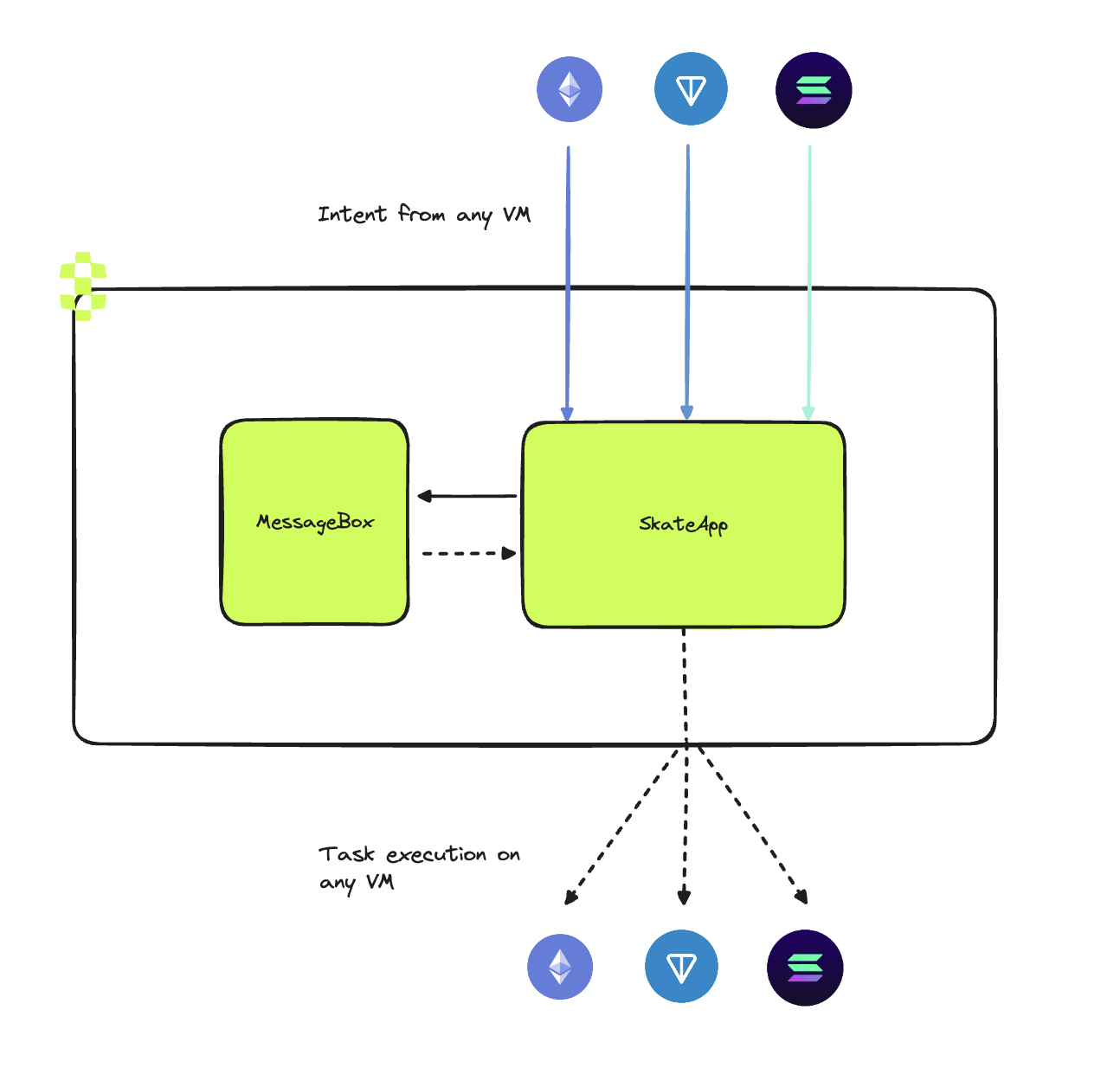
An overview of the interaction with Kernel is shown in the diagram below:
 ### Bytes-first messaging
All cross-boundary payloads are **`bytes`**. Each app defines its own encoding and math.
```solidity Intent (periphery → hub) theme={null}
struct Intent {
bytes32 actionId; // unique within origin chain (see below)
bytes32 user; // cross-VM user id
uint64 originChainId; // CHAIN enum
uint8 originVmType; // e.g., 1=EVM, 2=TON, 3=SVM, 4=Move, ...
address appAddress; // kernel manager on hub
bytes appCalldata; // app-defined
uint64 deadline; // optional
}
```
```solidity Task (hub → periphery) theme={null}
struct Task {
bytes32 actionId;
bytes32 recipient; // cross-VM recipient
uint64 destChainId; // explicit destination chain id
uint8 destVmType; // destination VM
address appAddress; // kernel manager reference
bytes taskCalldata; // app-defined settlement/refund payload
bool isRevert; // true = refund/revert on source
}
```
### Cross-VM addresses as `bytes32`
* **Ethereum/EVM:** 20 bytes left-padded to 32.
* **Solana (SVM):** base58 pubkey decoded to 32 bytes.
* **Sui/Aptos (Move):** already 32 bytes; store as-is.
All comparisons on the kernel use `bytes32`.
### Settlement, failure, refunds
* **Success:** task targets a **specific `destChainId` and `destVmType`**; periphery gateway verifies and settles from staged funds.
* **Failure (correct):** kernel emits a **revert task** back to the **source** periphery. That periphery runs the app’s refund logic for **that action only**.
* **Idempotent:** both settlement and revert must be safe to replay and must reject duplicates by `actionId`.
### Action identity and chain ids
* **Action ID:** unique **per origin chain**, computed as a hash of `(actionCount || chainId)`.
* **Chain ids (wrappers used for SVM/Move where needed):**
```solidity CHAIN enum theme={null}
enum CHAIN {
SKATE = 5050,
SOLANA = 901,
ECLIPSE = 902,
SOON = 903,
SUI = 1001,
APTOS = 1002,
MOVEMENT = 1003,
BASE = 8453,
ARBITRUM = 42161,
BSC = 56,
MANTLE = 5000,
OPTIMISM = 10,
ETHEREUM = 1,
HYPERLIQUID = 999,
PLUME = 98866,
ZG = 16661
}
```
### How any app uses this
* **Periphery:** stage assets (if any), pack **action bytes**, emit events.
* **Kernel manager:** validate, call core logic, emit **task(s)** with the right `destChainId`.
* **Core logic/state:** keep all app state on the hub.
* **Periphery gateway:** verify task, settle or refund **only that action**.
This is the whole model: one hub state, many periphery endpoints, and clean bytes-based messages.
## Kernel Composition
Here’s how the kernel fits together. It links user wallets across chains, accepts signed intents from apps, emits tasks for off-chain executors, and tracks settlement.
### What each contract does
* **AccountRegistry**: Binds a user’s wallets across VM types (EVM and non-EVM) into one account.
* **MessageBox**: Validates an intent, prevents duplicates, emits tasks, and marks them as settled.
* **SkateApp (base)**: App scaffold. Runs app logic, returns tasks, and hands them to MessageBox.
### How they work together
1. The relayer registers VM types and maps chain IDs.
2. A user links wallets. EVM signatures are checked on-chain. Non-EVM is recorded for off-chain checks.
3. The user signs an intent. The app calls `processIntent`.
4. App logic returns `Task[]`. `MessageBox` verifies the intent and emits `TaskSubmitted` events.
5. Executors pick up tasks and execute on the target chain(s).
6. The relayer calls `setTaskAsExecuted` to mark completion.
This ensures one user, many chains, a clean intent flow, and no double execution.
**Goal**: Keep one account number per user across VMs.
**What it stores**:
* **VM list**: `vm[vmType]` and `vmCount`.
* **Chain → VM type**: `chainIdToVmType`.
* **Wallet → account**: `references[keccak256(vmType, wallet)]`.
* **Account → wallets**: `accounts[accountNumber]` (array of `{vmType, addr}`).
* **Admin**: `_relayer`.
**Key calls**:
* `initialize(relayer)`: sets the relayer and seeds VM type 1 as "EVM".
* `registerVm(name)`: add a VM type (relayer only).
* `setVmTypesToChainIds(vmTypes[], chainIds[])`: map chains (relayer only).
* `bindWallet(vmType1, wallet1, vmType2, wallet2, sig1, sig2)`:
* VM types must be registered and in increasing order.
* If `vmType1 == 1`, `sig1` must recover to `wallet1` using the bind hash.
* If both wallets are new → create a new account and attach both.
* If one is already bound → attach the other to the same account.
* If both are already bound (to anything) → reject (no merging two existing accounts).
**Reads**: `getWallets`, `getWalletBindingStatus`, `getAccountNumber`, `getVmTypeByChainId`, `getVmCount`.
**Signature preimage (EVM binding)**:
`getBindEVMHash(wallet1, vmType2, wallet2)` encodes `(0, wallet1, vmType2, wallet2)` and uses the standard Ethereum signed message prefix.
**Permissions**:
* **Owner**: upgrades, set relayer.
* **Relayer**: VM admin + wallet binding entrypoint.
**Goal**: Be the outbox everyone trusts. Validate once. Emit tasks once. Mark settlement once.
**What it stores**:
* `_executorRegistry`: who can originate task submissions (`tx.origin` is checked).
* `_relayer`: marks settlement.
* `_taskId`: running counter.
* `_isTaskExecuted[taskId]`: settlement flag.
* `_isActionExecuted[chainId][actionId] → taskId`: global dedup index.
* `_nonce[user]`: per-user nonces for replay protection.
**Key calls**:
* `submitTasks(tasks, intent)`:
* Caller must be the app: `msg.sender == intent.intentData.appAddress`.
* `tx.origin` must be an approved executor.
* `intent.vmType` must be non-zero.
* If EVM (`vmType == 1`) and `intent.signature` is present:
* Recover signer from `keccak256( user, nonce[user], appAddress, keccak256(intentCalldata) )` with the Ethereum signed message prefix.
* Signer must equal `user`.
* Non-EVM signatures: emitted as an event for off-chain checks.
* Increments the user nonce after checks.
* Dedup rule: for each `(srcChainId, actionId)`, ensure it wasn’t executed before. Duplicates inside the same batch are allowed and skip the history check.
* Emits one `TaskSubmitted` per task and records `actionId → taskId`.
* `setTaskAsExecuted(taskId, settlementInfo)`:
* Relayer marks a task as executed. Emits `TaskExecuted`.
**Reads**: `executorRegistry`, `taskId`, `isTaskExecuted(taskId)`, `isActionExecuted(chainId, actionId)`, `nonce(user)`, `getDataHashForUser(...)`.
**Why it’s safe**:
App-only submission, executor allow-list, per-user nonce, and `(chainId, actionId)` dedup keep intents honest and idempotent.
**Goal**: Make writing apps simple. You focus on building tasks; the kernel handles the rest.
**What it stores**:
* `_messageBox` and `_accountRegistry`.
* `_chainIdToPeripheryContract[chainId] → bytes32`.
* `_chainIds[]` for discovery.
**Key calls**:
* `__SkateApp_init(messageBox, accountRegistry)`: wire dependencies.
* `setChainToPeripheryContract(chainId, peripheryContract)`:
* Set or clear the periphery address for a chain.
* Keeps `_chainIds` in sync.
* `processIntent(intent)`:
* Calls `address(this).functionCall(intent.intentData.intentCalldata)`.
* Expects your function to return `IMessageBox.Task[]`.
* Submits those tasks to `MessageBox`.
**Extras**: `onlyContract` modifier is available for internal orchestration.
**Lookups**: `chainIdToPeripheryContract`, `messageBox`, `accountRegistry`, `getChainIds`.
### Roles
* **Owner (per contract)**: Upgrades and wiring.
* **Relayer**: Registry admin; marks settlement in MessageBox.
* **Executor (EOA)**: Must be whitelisted; originates task submissions.
* **App contract**: Must be the direct caller of `submitTasks`.
### Bytes-first messaging
All cross-boundary payloads are **`bytes`**. Each app defines its own encoding and math.
```solidity Intent (periphery → hub) theme={null}
struct Intent {
bytes32 actionId; // unique within origin chain (see below)
bytes32 user; // cross-VM user id
uint64 originChainId; // CHAIN enum
uint8 originVmType; // e.g., 1=EVM, 2=TON, 3=SVM, 4=Move, ...
address appAddress; // kernel manager on hub
bytes appCalldata; // app-defined
uint64 deadline; // optional
}
```
```solidity Task (hub → periphery) theme={null}
struct Task {
bytes32 actionId;
bytes32 recipient; // cross-VM recipient
uint64 destChainId; // explicit destination chain id
uint8 destVmType; // destination VM
address appAddress; // kernel manager reference
bytes taskCalldata; // app-defined settlement/refund payload
bool isRevert; // true = refund/revert on source
}
```
### Cross-VM addresses as `bytes32`
* **Ethereum/EVM:** 20 bytes left-padded to 32.
* **Solana (SVM):** base58 pubkey decoded to 32 bytes.
* **Sui/Aptos (Move):** already 32 bytes; store as-is.
All comparisons on the kernel use `bytes32`.
### Settlement, failure, refunds
* **Success:** task targets a **specific `destChainId` and `destVmType`**; periphery gateway verifies and settles from staged funds.
* **Failure (correct):** kernel emits a **revert task** back to the **source** periphery. That periphery runs the app’s refund logic for **that action only**.
* **Idempotent:** both settlement and revert must be safe to replay and must reject duplicates by `actionId`.
### Action identity and chain ids
* **Action ID:** unique **per origin chain**, computed as a hash of `(actionCount || chainId)`.
* **Chain ids (wrappers used for SVM/Move where needed):**
```solidity CHAIN enum theme={null}
enum CHAIN {
SKATE = 5050,
SOLANA = 901,
ECLIPSE = 902,
SOON = 903,
SUI = 1001,
APTOS = 1002,
MOVEMENT = 1003,
BASE = 8453,
ARBITRUM = 42161,
BSC = 56,
MANTLE = 5000,
OPTIMISM = 10,
ETHEREUM = 1,
HYPERLIQUID = 999,
PLUME = 98866,
ZG = 16661
}
```
### How any app uses this
* **Periphery:** stage assets (if any), pack **action bytes**, emit events.
* **Kernel manager:** validate, call core logic, emit **task(s)** with the right `destChainId`.
* **Core logic/state:** keep all app state on the hub.
* **Periphery gateway:** verify task, settle or refund **only that action**.
This is the whole model: one hub state, many periphery endpoints, and clean bytes-based messages.
## Kernel Composition
Here’s how the kernel fits together. It links user wallets across chains, accepts signed intents from apps, emits tasks for off-chain executors, and tracks settlement.
### What each contract does
* **AccountRegistry**: Binds a user’s wallets across VM types (EVM and non-EVM) into one account.
* **MessageBox**: Validates an intent, prevents duplicates, emits tasks, and marks them as settled.
* **SkateApp (base)**: App scaffold. Runs app logic, returns tasks, and hands them to MessageBox.
### How they work together
1. The relayer registers VM types and maps chain IDs.
2. A user links wallets. EVM signatures are checked on-chain. Non-EVM is recorded for off-chain checks.
3. The user signs an intent. The app calls `processIntent`.
4. App logic returns `Task[]`. `MessageBox` verifies the intent and emits `TaskSubmitted` events.
5. Executors pick up tasks and execute on the target chain(s).
6. The relayer calls `setTaskAsExecuted` to mark completion.
This ensures one user, many chains, a clean intent flow, and no double execution.
**Goal**: Keep one account number per user across VMs.
**What it stores**:
* **VM list**: `vm[vmType]` and `vmCount`.
* **Chain → VM type**: `chainIdToVmType`.
* **Wallet → account**: `references[keccak256(vmType, wallet)]`.
* **Account → wallets**: `accounts[accountNumber]` (array of `{vmType, addr}`).
* **Admin**: `_relayer`.
**Key calls**:
* `initialize(relayer)`: sets the relayer and seeds VM type 1 as "EVM".
* `registerVm(name)`: add a VM type (relayer only).
* `setVmTypesToChainIds(vmTypes[], chainIds[])`: map chains (relayer only).
* `bindWallet(vmType1, wallet1, vmType2, wallet2, sig1, sig2)`:
* VM types must be registered and in increasing order.
* If `vmType1 == 1`, `sig1` must recover to `wallet1` using the bind hash.
* If both wallets are new → create a new account and attach both.
* If one is already bound → attach the other to the same account.
* If both are already bound (to anything) → reject (no merging two existing accounts).
**Reads**: `getWallets`, `getWalletBindingStatus`, `getAccountNumber`, `getVmTypeByChainId`, `getVmCount`.
**Signature preimage (EVM binding)**:
`getBindEVMHash(wallet1, vmType2, wallet2)` encodes `(0, wallet1, vmType2, wallet2)` and uses the standard Ethereum signed message prefix.
**Permissions**:
* **Owner**: upgrades, set relayer.
* **Relayer**: VM admin + wallet binding entrypoint.
**Goal**: Be the outbox everyone trusts. Validate once. Emit tasks once. Mark settlement once.
**What it stores**:
* `_executorRegistry`: who can originate task submissions (`tx.origin` is checked).
* `_relayer`: marks settlement.
* `_taskId`: running counter.
* `_isTaskExecuted[taskId]`: settlement flag.
* `_isActionExecuted[chainId][actionId] → taskId`: global dedup index.
* `_nonce[user]`: per-user nonces for replay protection.
**Key calls**:
* `submitTasks(tasks, intent)`:
* Caller must be the app: `msg.sender == intent.intentData.appAddress`.
* `tx.origin` must be an approved executor.
* `intent.vmType` must be non-zero.
* If EVM (`vmType == 1`) and `intent.signature` is present:
* Recover signer from `keccak256( user, nonce[user], appAddress, keccak256(intentCalldata) )` with the Ethereum signed message prefix.
* Signer must equal `user`.
* Non-EVM signatures: emitted as an event for off-chain checks.
* Increments the user nonce after checks.
* Dedup rule: for each `(srcChainId, actionId)`, ensure it wasn’t executed before. Duplicates inside the same batch are allowed and skip the history check.
* Emits one `TaskSubmitted` per task and records `actionId → taskId`.
* `setTaskAsExecuted(taskId, settlementInfo)`:
* Relayer marks a task as executed. Emits `TaskExecuted`.
**Reads**: `executorRegistry`, `taskId`, `isTaskExecuted(taskId)`, `isActionExecuted(chainId, actionId)`, `nonce(user)`, `getDataHashForUser(...)`.
**Why it’s safe**:
App-only submission, executor allow-list, per-user nonce, and `(chainId, actionId)` dedup keep intents honest and idempotent.
**Goal**: Make writing apps simple. You focus on building tasks; the kernel handles the rest.
**What it stores**:
* `_messageBox` and `_accountRegistry`.
* `_chainIdToPeripheryContract[chainId] → bytes32`.
* `_chainIds[]` for discovery.
**Key calls**:
* `__SkateApp_init(messageBox, accountRegistry)`: wire dependencies.
* `setChainToPeripheryContract(chainId, peripheryContract)`:
* Set or clear the periphery address for a chain.
* Keeps `_chainIds` in sync.
* `processIntent(intent)`:
* Calls `address(this).functionCall(intent.intentData.intentCalldata)`.
* Expects your function to return `IMessageBox.Task[]`.
* Submits those tasks to `MessageBox`.
**Extras**: `onlyContract` modifier is available for internal orchestration.
**Lookups**: `chainIdToPeripheryContract`, `messageBox`, `accountRegistry`, `getChainIds`.
### Roles
* **Owner (per contract)**: Upgrades and wiring.
* **Relayer**: Registry admin; marks settlement in MessageBox.
* **Executor (EOA)**: Must be whitelisted; originates task submissions.
* **App contract**: Must be the direct caller of `submitTasks`.